Work-life balance is bullshit. I've been saying it for years. But only recently did I figure out how to act on the alternative.
It's all about work-life integration. You've heard that before. Maybe you've said it yourself. But when someone asks, "Okay, so what does work-life integration actually look like?" most gurus go quiet. Because there is no formula. It's not two-plus-two-equals-four.
Your version of a good life looks different from mine. And both look different from what they looked like five years ago. Kids change it. A move changes it. A health scare changes it. An aging parent changes it. Do you have children? More than one? Are you married? Do you live near family? Have you had a life-or-death experience that rewired how you think about time? All sorts of experiences can change what the ideal looks like for you.
So not only is there no formula for work-life integration. It looks different for everybody. And it changes over time.
Great. So what are we supposed to do with that?
The Framework: Owner's Clarity
It's a set of four constraints that you, as a founder, are inevitably going to place on the business you started and run. Whether you have clarity about them or not.
I wrote an initial breakdown of these constraints a few months ago in The 4 Constraints That Quietly Kill Founders (and their firms). If you haven't read that, start there. It's the structural foundation for everything I'm about to say. Today, I'm going deep into framework itself. I want to show you how the four constraints connect to something bigger: resilience. And I want to show you what it actually looks like when a founder follows the standard advice without running it through these constraints first. Because I did exactly that in my first agency.
The four constraints: Purpose, Identity, Intent, and Capacity.
They change. They evolve as you move through different stages of life. But they are always operating. And if you don't act on them deliberately, they will still be there—making you feel like an imposter in your own firm, or irrelevant to the market.
Constraint #1: Purpose — Why Do You Get Up Every Morning?
Not passion. Purpose.
I avoid the word passion because passion is what you feel, and you can feel it for a lot of things. I'm passionate about working out, staying fit. Does that mean I need to start a gym or a wellness company? I'm passionate about being a Liverpool fan. Does that mean I should build a merchandise company? I'm passionate about being a parent. Does that mean I need to start a daycare?
I'm passionate about a lot of things. Writing, reading, sharing ideas. But what's the purpose? Why do I get up every morning and what gives me energy?
Purpose is directional. Passion is fleeting.
Purpose is the thing that gives you energy when everything else is draining it. What do you deeply care about? Not what are you passionate about. What do you deeply care about as a person, not just as an entrepreneur?
For me, it's helping people around me learn more about themselves and about each other. In my business, that translates to helping founders uncover things about themselves that they haven't named yet. When I do that work, I have energy. When the dots connect, and a founder sees the through line from their clarity to their business performance for the first time, the energy in the room changes. I live for that moment. But that moment is fleeting, and sometimes getting to that moment is extremely draining. But yet, I push through because of my purpose.
If your business does not connect to your purpose, you will burn out inside it. Not might. Will. It's just a matter of when. And that's not a mindset problem. That's a positioning problem.
This isn't just my lived experience or intuition. Psychologists Richard Ryan and Edward Deci spent decades studying what actually drives people. Their Self-Determination Theory (Ryan & Deci, 2000) breaks it down into three basic needs: autonomy (you feel like you're choosing your own behavior), competence (you feel like you can actually be effective), and relatedness (you feel connected to other people). When those three needs are met, people show up motivated and well. When they're blocked, burnout follows. It's not a theory about happiness. It's a theory about what happens when your environment fights your wiring.
The Research Behind Purpose
The purpose-versus-passion distinction is thoroughly supported by psychology research. Ryan and Deci published the core of this work in American Psychologist in 2000. The finding is simple: people who do things because the work itself is meaningful—intrinsic motivation—outperform, persist longer, and report higher well-being than people chasing external rewards. Status, money, image. Those extrinsic motivators work in the short term, but aren't sustainable.
Their later work (2017) went deeper. They separated intrinsic goals—growth, connection, contribution—from extrinsic goals—wealth, fame, appearance. People who build their lives around intrinsic goals are more satisfied. People who build their lives around extrinsic goals report more anxiety and lower life satisfaction, even when they reach them. The goal itself doesn't fix the problem if the goal isn't connected to something real inside the person.
That's the mechanism behind the burnout I'm describing. When your business doesn't connect to your purpose, your need for autonomy gets blocked. You're not choosing your behavior anymore. The business is choosing it for you. The business becomes something that happens to you rather than something you drive. This has been tested across thousands of studies in dozens of countries. Blocked needs don't just make you less motivated. They create measurable psychological distress. Burnout is a predictable result of building a business that's disconnected from what actually drives you.
Constraint #2: Identity — Who Are You, Really?
This is where people get confused. Sometimes they confuse what they're passionate about for their identity. Sometimes they confuse the roles they hold, in their business or in their family, with who they actually are.
A role can be an identity, but an identity is not always a role. A square is always a rectangle, but a rectangle is not always a square. That one is for all you math nerds out there. Not actually something I am terribly passionate about, but I like the analogy.
I’m a father. It is the most important role I will ever have. It has changed me completely, and it dictates how I spend my time and my money. But there is a difference between a role, even a sacred one such as a parent, and your core wiring as an individual. I am a builder and a mentor. That is my wiring. I use that wiring when I’m helping my kids navigate life, and I use that wiring when I’m helping founders navigate their firms. The roles are different (parent vs. advisor), but the underlying identity—the thing that defines me—is identical.
We get into trouble when we confuse the roles we play with the wiring underneath. Same thing inside a business. 'I'm a CEO.' That's a role. 'I'm an owner.' That's a title. But who are you, really?"
Here are some common identities: builder, fixer, mentor, strategist, problem solver. Here's the key test: your identity is generally not environmentally specific. A builder builds at work, at home, in their community, in their religious organization. A mentor mentors everywhere. A CEO is only a CEO at work. A board member is only a board member in the boardroom.
If your business does not support at least one of your core identities, you end up doing one of two things.
You pretend. You pretend to be the person who doesn't need or want those things. And pretending is not something you do for an afternoon. You are pretending at least eight hours a day, five-plus days a week, fifty-two weeks a year. That's exhausting.
Or you go find your fix elsewhere. You start some internship program that doesn't make business sense, just so you can scratch the itch your own firm won't let you scratch. This a real example of a founder who had such a need to be seen as a mentor that he started an internship program inside an organization that differentiated itself by only having senior industry executives on staff. I've seen founders volunteer excessively. I've seen them start pet projects. Not because they were strategic business decisions, but because their business wasn't feeding the part of them that needed to be fed. Their identity.
What I'm describing here, psychology research has already proven.
Researchers Isla O'Neil and Deniz Ucbasaran spent three years tracking founders and found that we don't just step into a pre-built 'founder' role. We have to actively bend the business to fit our personal wiring—a process they call founder authenticity work (Journal of Business Venturing, 2019).
The Research Behind Identity
The role-versus-identity distinction has been studied for decades. Robert Kegan called it entering the "self-authoring mind". Most people live in a state where they are their roles. If they are a parent, or a CEO, that role completely defines their identity. But psychologically mature leaders learn to make a shift. They go from being their roles to having their roles.
O'Neil and Ucbasaran's 2019 study went further. What they found is founders who pulled off aligning the person with the business, persisted and thrived. Founders who couldn't close that gap experienced what the researchers call identity tension. The distance between who you are and who your business needs you to be. That tension compounds over time.
Wagenschwanz and Grimes extended this in 2021, in the Journal of Business Venturing. They showed that founder authenticity doesn't just affect the founder. It radiates. When the founder's personal identity and business identity are aligned, their teams buy in more deeply. When there's a gap, the team feels it. Misalignment doesn't stay contained. It leaks into the culture, the positioning, the way the firm shows up in the market.
The environmental-specificity test I use—a builder builds everywhere, a CEO is only a CEO at work—is a fast way to separate personal identity from role identity. It lines up with how the research defines the distinction, and it gives founders a concrete diagnostic. Which parts of who you actually are is your business supporting, and which parts is it starving?
Constraint #3: Intent — What Do You Need From This Business?
Intent is specific. Financial and emotional.
How much money do you want to make? What do you want to do with that money? How do you want to feel when you come home at the end of the day? How do you want to feel at work? What kinds of people do you want to work with? How many vacations do you want to take? How much time do you want to dedicate to work in any given week? How do you want to exit your business, and why?
I was talking to a founder of a five-million-dollar firm the other day. Been in business for almost a decade. I asked him: "What's your endgame? How do you. plan to exit your firm?" He couldn't answer. Couldn't even start.
Sometimes I get a surface-level answer. "I want to build a legacy." Okay, what does that mean? Does it mean passing the firm to your children? Starting a foundation? Being the best-known firm in your niche? Your name on a building at your alma mater? What does legacy mean to you? Specifically, without censoring it based on what others may think.
Most can't answer that. But here's what's interesting: while most founders can't define their endgame, virtually every single one can give me a number. "I want to get to ten million." Okay. Why ten?
Is it because somebody told you that at ten million you get better EBITDA multiples? Is there something magical about the number? Or have you actually done the math? Have you said: "I own this percentage of the company. For this to be a life-changing exit, the enterprise value needs to be X. After the two-year earn-out, I receive Y. And with that, I can do Z."
Most founders have never done that math. And here's the follow-up they definitely haven't considered: let's say you're forty and you sell your firm at fifty, for the multiple you expected. Not very likely, if you haven't done this work, because your business won't be resilient enough to justify that multiple, but let's pretend. After the earn-out you're fifty-two. You don't have a firm anymore. What are you going to do? What's the plan?
"I want to spend more time with family." How much more than you're spending now? And have you thought about what that looks like five or ten years from now, when you're actually going to sell? Because what you'd do with your family today—when you have young children—is not the same as what you'd do when your kids are in high school or already off at college.
"What is your endgame with this business, and why?" is one of the most powerful questions a founder can answer. Because from that question, you can explore your purpose, your identity, your intent in a way that surfaces what's actually driving you. It's not a magic bullet. You still have to do the deep work afterward. But it's where I almost always start.
If you can't define your intent, your business will eventually become something you resent. Not because it failed, but because it succeeded at something you never actually wanted.
The science on this one is straightforward. Locke and Latham's Goal-Setting Theory is one of the most replicated findings in organizational psychology. Specific, challenging goals produce significantly higher performance than vague or easy ones (Locke & Latham, American Psychologist, 2002). The $5M founder who couldn't define his endgame is the control group. No specific target. No mechanism for persistence.
The Research Behind Intent
Locke and Latham followed up their initial research in 2006, with two findings that matter for founders. First, goals work best when you're genuinely committed to them. Not assigned them. A founder who says "I want to get to ten million" because an advisor told them to isn't committed to that goal. They haven't done the math. They haven't connected the number to an actual life outcome. There's no real commitment because the target is hollow. It's a specific number, but it doesn't mean anything to them personally. Second, you need a feedback loop. You need to know whether you're on track. And if you haven't defined the target in concrete terms, there's nothing to measure against. That's why the founder without a clearly defined endgame never really feels like they are moving in the right direction.
A 2025 systematic review of goal-setting research confirmed this pattern. Clarity, attainability, and continuous monitoring drive productivity, motivation, and satisfaction. But the review also found something worth paying attention to. Goals that are too aggressive and disconnected from what you can actually sustain actually backfire. They hurt perceived performance and motivation. That's why Intent and Capacity are separate constraints in my framework. Specificity without realism is just pressure. And pressure without purpose is a recipe for resentment.
The endgame question I use with founders is all about getting at that specificity. It forces vague goals like "build a legacy," "get to ten million" into concrete terms: ownership percentage, enterprise value, earn-out timeline, post-exit plan. Once you make the goal specific,your attention narrows, your effort increases, persistence becomes sustainable and strategy becomes possible. Without that specificity, none of those mechanisms activate, and you drift toward an outcome you never deliberately chose.
Constraint #4: Capacity — What Can You Actually Sustain?
What are you good at? What are you not good at? What do you enjoy doing? What drains you? And how long can you sustain doing work you don't enjoy before it breaks you?
Because inevitably, as entrepreneurs and business owners, we all have to do some work we don't enjoy. The question isn't whether you'll have to. The question is: how long can you sustain it without burning out?
Part of capacity is understanding the difference between things you're bad at (and should hire for) and things you're good at but hate doing (and should also hand off). And the flip side: things you're good at and enjoy. In case you haven't connected the dots yet, I'll spell it out for you—the things you enjoy are likely to be related to your identity. That's your zone of genius. Design your role around staying in that zone as often as possible.
The research backs this up directly. Amy Wrzesniewski and Jane Dutton's work on Job Crafting (Academy of Management Review, 2001) showed that people who actively reshape their work to fit their strengths, motives, and sense of identity report greater engagement, more satisfaction, and more resilience. A meta-analysis across 122 independent samples confirmed it: job crafting drives engagement up and burnout down (Rudolph et al., 2017).
The Research Behind Capacity
Wrzesniewski and Dutton's 2001 paper showed that people aren't passive. They reshape their work to fit who they are, based on their motives, their strengths, their sense of self. The job description is just the starting point.
They broke job crafting into three types. Task crafting: changing what you actually do. Relational crafting: changing who you interact with. Cognitive crafting: changing how you think about the meaning of the work. People do this because they need control over their work, they need the work to reflect a person they're willing to be, and they need human connection.
Their earlier work (1997) had already shown that whether someone experiences their work as a job, a career, or a calling has almost nothing to do with the occupation. It depends on the person. Two people can be in the same role, same company, same title, but one experiences it as a calling, the other as a grind. Job crafting is the mechanism that explains the difference.
This connects to the Job Demands-Resources model (Demerouti, Bakker, Nachreiner & Schaufeli, Journal of Applied Psychology, 2001). Two parallel processes are at work: Demands (workload, time pressure, emotional labor, etc.) can lead to burnout, Resources (autonomy being the most important for founders) can lead to better engagement. A 2022 study in Journal of Business Venturing applied this specifically to entrepreneurs. Entrepreneurs are more engaged than employees, and autonomy is the reason. But the study also explained why so many founders feel simultaneously wired and exhausted; it identified that engagement and burnout can coexist. You can love the work and be destroyed by it at the same time. That's what happens when you have resources in some areas and demands in others that you haven't addressed.
Gallup's 2018 data puts a number on it. People who use their strengths daily are six times more likely to be engaged and three times more likely to report excellent quality of life. That's the case for what Gay Hendricks calls the zone of genius—the overlap of things you enjoy, things you're good at, and things nobody else in your firm can do as well as you. The standard advice—"remove yourself from day-to-day operations"—is top-down job design. My framework is bottom-up job crafting for founders. The right answer depends on which parts of "day-to-day" give you energy and which ones drain you. And you can't know that without clarity of capacity.
What Happens When You Follow the Standard Advice Without These Constraints
This matters because the standard advice given to founders is woefully incomplete and devoid of context. And I know this because I followed every word of it at one point.
The playbook goes like this... Pick a tight niche. Productize your services, because if you don't productize, you can't scale. Remove yourself from day-to-day operations. And remove yourself from sales and business development.
It's fine general advice, but it's devoid of the most important context. You.
I lived this. I followed this exact advice. Here's how it played out.
I niched down into demand generation for technical professional services firms. It was opportunistic—that happened to be where some of our clients were, and it made sense on paper. Were we passionate about that industry? Not exactly. Did we deeply care about progressing those specific founders? Not particularly. It was convenient.
I productized. Standard offerings, flat pricing, monthly retainers, systematized delivery. On its own, not a bad thing. But productize to what end? And productize versus modularize versus custom—those are different decisions with different implications. The right answer depends on who you want to work with, which depends on who you are as a person. I didn't ask myself that question. I just followed the playbook.
I pulled myself out of operations. We promoted someone to a Director of Ops role. That was the right call. I genuinely don't enjoy operations. This is the one thing I got right.
I pulled myself out of strategy work. We brought on directors to handle it. Bad decision. I actually enjoyed working with clients and solving their problems. Builder, strategist, problem solver—that's who I am. That's my identity. Removing myself from client strategy made me miserable inside my own business.
I pulled myself out of business development. I promoted someone to a Director of Growth role. Worse decision. Turns out I enjoy business development. I like the go-to-market work. I like being in front of people and building relationships. And as someone who gets energy from people, developing better business development skills only made me enjoy it more.
This was the opposite of Job Crafting. I let an external playbook dictate my role, pulling myself out of client strategy and BD because "that's what founders do to scale".
Out of the four standard pieces of advice, I got one right. One out of four. And the one I got right—operations—was right specifically because it aligned with my capacity. The other three violated my identity and capacity. And because I hadn't done the deep work required to understand my purpose, the business was completely devoid of that, which caused me to continuously get distracted. Only in hindsight do I now realize that I was using these various distractions as ways to search for that purpose.
The only thing that made these decisions wrong was the absence of Owner's Clarity. The advice itself wasn't bad. It was missing the most important context. Me.
If you remove yourself from the parts of the business that give you energy, you'll build a firm you're no longer excited about. And once that happens, you've got two options: adjust early enough to recover, or exit too early, underprepared, and probably not with the result you were shooting for.
The Investment Most Founders Have Never Made
If you are the founder of a boutique firm, especially sub-fifty people or sub-ten million in revenue, your business depends on you. You are making all the critical decisions. Setting the vision. Building the culture. Modeling behavior. Deciding how much to invest in growth, in people, in everything. Deciding who to hire and how.
Do you know why you're making those decisions? Do you understand the thinking and the emotion behind them? Do you understand where it's coming from?
How can you build a firm that's true to you if you can't answer those questions?
We invest in everything else. Tools, training, teams, conferences, certifications. We'll get sales training and leadership coaching and go to every industry event. But the investment in actually understanding ourselves on a deeper more fundamental level—why you do what you do, why you think what you think—that's the one most founders skip.
The data backs this up. Self-awareness is one of the strongest predictors of leadership effectiveness. Self-aware leaders perform better, get promoted more, and their people are more satisfied and less likely to leave (Amundsen & Martinsen, The Leadership Quarterly, 2014).
The Research Behind Self-Awareness
Not being self-aware is more likely to drive cognitive dissonance.
It isn't just wanting two conflicting things. Leon Festinger’s foundational research (1957) shows that the real damage occurs when your actions directly contradict your self-concept.
If you believe you are a family-first person (Identity), but your daily actions require you to work eighty hours a week to chase an arbitrary scale target (Action), your brain enters a state of high distress.
To resolve the psychological pain of that hypocrisy, you have to start lying to yourself. You justify the late nights, ignore the fatigue, and pretend you're fine. As psychologist Elliot Aronson pointed out, this conflict isn't logical—it's psychological. It tears at who you believe you are."
What makes this especially damaging for founders is something more recent research clarified. Harmon-Jones and Harmon-Jones (2007) showed that dissonance hits hardest when you need to act and the conflict between your competing beliefs blocks effective action. That's the founder's life. You have to make decisions every day—pricing, hiring, taking on new business, building out new service lines. And when your constraints are undefined, every one of those decisions becomes a miniature dissonance event. You're not just deciding what to do. You're trying to figure out who you're doing it for.
The self-awareness research closes the loop. A review out of Fisher College of Business at Ohio State (Li, 2019) found that self-aware leaders—leaders whose self-assessments match how others see them—perform better, lead more effectively, and get promoted more often. Their teams are more satisfied and stick around longer (NOTE: the same is true of business, by the way, and that's what the rest of my positioning work focuses on—closing the gap between how you want the firm to be seen and how the market actually sees it). The mechanism is straightforward. Self-aware leaders know what they're good at and what they're not good at. They set realistic goals. They respond to feedback instead of deflecting it. The Owner's Clarity Framework turns self-awareness from a vague aspiration into four specific constraints you can actualy define and operationalize. It gives you a structure for the work that the research says matters most.
Why This Is a Positioning Problem, Not a Self-Help Problem
And here's the part that the majority of the business and lifestyle design coaching industry misses. This is actually structural business strategy for founder-led firms. This is a core input to your positioning.
Positioning is a ledger of your strategic decisions, trade-offs, and investments. It's about what you say yes to and what you say no to. Who you choose to work with and who you don't. Problems you choose to solve and problems you walk away from.
In the vast majority of boutique firms, there's only one person who has the authority to make these kinds of decisions, investments, and capital allocations. Only one person has veto and signatory power. That's the founder.
So if that's true—and it most definitely is—then it stands to reason that the founder's own values, opinions, purpose, identity, intent, and capacity are all central to positioning. They either drive it, or they undermine it. Often, founders end up contradicting themselves, knowingly or unknowingly, because they haven't done this work.
People question my focus on the founder. And not just the focus—the way I focus. Purpose and identity seem warm and fuzzy. Sort of "wouldn't that be nice." Here's the thing. This isn't about warm and fuzzy. It's about clarity. Clarity of vision. Seeing oneself, understanding oneself, and then using that information to design the firm in a way that supports you.
Because when you do, your firm is designed not around you as a dependency, but in support of you as a driving force. You can make the critical decisions necessary to form a coherent position that your team can get behind, because you understand it, and they understand you.
The business needs to be built not around the founder as a dependency or a crutch, but in support of the founder as a core driving force.
Happy founder, happy firm.
If you haven't read Ambiguous Positioning Causes Burnout, go read it after this. It maps the three specific burnout patterns that emerge when Owner's Clarity, Positioning Intent, and Positioning Reality don't line up. It will show you exactly why your burnout isn't a mindset problem, but a positioning problem.
From Constraints to Resilience
Now here's where all four constraints connect to something founders rarely talk about in structural terms: resilience.
I was talking with a founder of a small firm recently, and two words came up in conversation that struck me. Not because they were new, but because she arrived at them on her own. Those two words were discipline and authenticity.
What she was really describing, though she never used the word, was resilience. We ended up reverse-engineering my entire Owner's Clarity Framework in that conversation.
Resilience is the end goal. Being a founder is not a cakewalk. There are easier ways to make money. So we need to be resilient. And what we reverse-engineered was this: Authenticity + Discipline = Resilience.
Many will tell you to "be authentic" and "be disciplined." Almost nobody can tell you what those things are actually made of, or how to develop them. So let me break it down.
Authenticity Requires Clarity of Purpose + Clarity of Identity
I wrote a post years ago claiming that authenticity had jumped the shark. Because everybody—and I mean everybody—was telling founders to "just be authentic" without defining what that meant. "Be yourself and share everything." That's not authenticity. That's oversharing.
Authenticity requires two things: clarity of purpose and clarity of identity.
When you know why you do what you do—not just as an entrepreneur, but as a person—and when you know who you are at your core, not the roles you play but the identity traits that make you different from other people who hold those same roles, you can actually be authentic.
You can build a business that supports both of those things. And when you do, you can be yourself in front of your clients, with your employees, in your content, with your audience. You don't need to manufacture authenticity. Manufacturing it is an oxymoron. The act of manufacturing it means it's no longer authentic.
But you can enable it. You enable it by having clarity of purpose, clarity of identity, and building a business that supports those things and allows you to be authentic day-to-day. Which makes things less stressful. You don't have to pretend to be somebody else. You can be you in front of others because you have that clarity.
This is what I called Brand Integrity in The 4 Constraints article: Purpose + Identity = Brand Integrity. The market-facing story, positioning, and culture match who you are and why the firm exists. Authenticity is what makes Brand Integrity possible.
Discipline Requires Clarity of Intent + Clarity of Capacity
Discipline is the other half. And it's important not to confuse it with willpower. Willpower is finite and short-term, while discipline is a system that decreases your need for consistent willpower.
Discipline requires two things: clarity of intent and clarity of capacity.
It's hard to be disciplined for discipline's sake. Yes, you can build habits, and habits are important. But it's hard to build a habit for no reason. You need an objective you're striving toward—something the habit exists to achieve.
Simple example: you're trying to get up early and exercise. Why? If you don't have an objective—lose a certain amount of weight, run a marathon on a specific date, fit into certain clothes, compete in something—it's going to be hard to sustain. No matter what kind of habit-building hacks you use, at some point there won't be the right level of reinforcement without a clear why.
That's clarity of intent. Why are you doing the thing?
You also need clarity of capacity. Each of us only has so much willpower, so we have to create habits that work within our existing system. What are the things you already enjoy? What are you already good at? How do you use those as leverage to build the habits you need?
If you're already a morning person, work out in the mornings. If you enjoy tennis, join a gym with a tennis court—do the workout, then play a match as the reward. Use what you have.
Have you identified your intent for running this firm? How much money do you need for the lifestyle you want? Get specific. And what about capacity? Are you good at business development? Do you enjoy it? Is it something you could get better at, and if you did, would you enjoy it? Do you enjoy finance and accounting? Operations? Client delivery?
Design your role so it puts you in your zone of genius—the overlap of things you enjoy (likely because of your identity), things you're good at, and things nobody else in your firm can do as well as you. Don't just follow blanket advice to "extricate yourself from the day-to-day." Figure out what that actually means for you.
When you have clarity of intent, you'll be disciplined about margin, about pricing, about the kind of work you take on and the kind you walk away from. When you have clarity of capacity, you'll build systems and operating procedures, the habits that keep you in your zone while uncompromisingly moving the business forward.
This is what I called Operating Discipline in the 4 Constraints article: Intent + Capacity = Operating Discipline. The growth plan stays inside real constraints, with boundaries that hold.
The Full Architecture
Here's how it all connects:
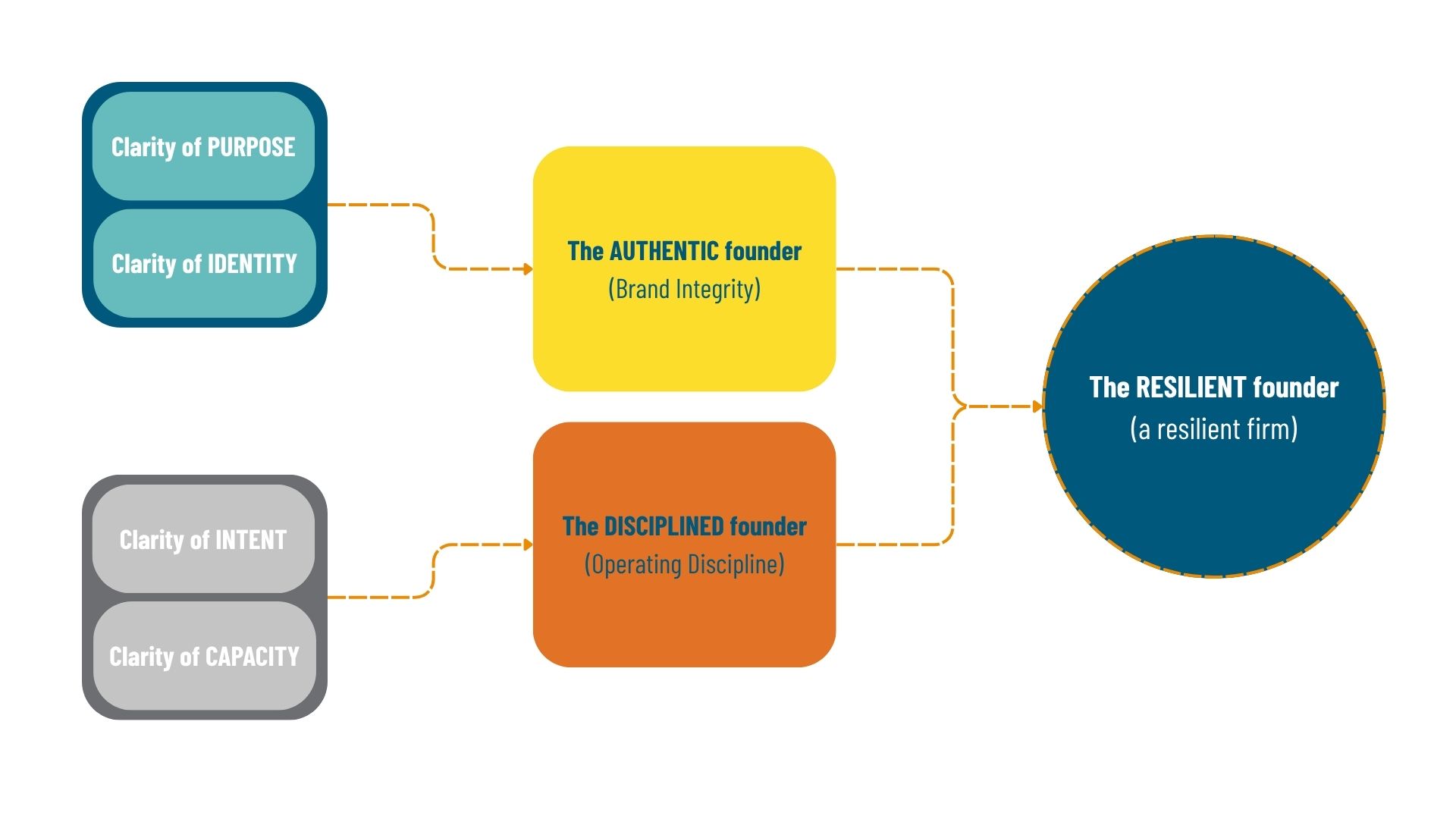
Clarity of Purpose + Clarity of Identity = Authenticity = Brand Integrity.
Clarity of Intent + Clarity of Capacity = Discipline = Operating Discipline.
Brand Integrity + Operating Discipline = Resilience.
A resilient founder = a resilient firm.
That's the Owner's Clarity Framework. Purpose, Identity, Intent, Capacity. Four constraints that every founder places on their business. Define them deliberately, and you get authenticity, discipline, and resilience. Leave them undefined, and you get cognitive dissonance, burnout, and a firm that doesn't fit you.
Every meaningful decision you make should clear four gates: Does it support my Purpose? Does it reinforce my Identity? Does it deliver my Intent in measurable terms? Does it fit my Capacity sustainably? That's the framework that builds resilience, for you and for your firm.
This test applies to clients you accept, offers you build, hires you make, growth motions you invest in, and roles you keep for yourself. It's not a one-time exercise. These constraints change as you change. The framework is designed to evolve with you.
Where to Start
One question. Answer it honestly: "What is your endgame with this business, and why?"
Sounds simple. It's not easy. Because if you do it right, it forces you to deal with some difficult follow-up questions about your purpose, your identity, your intent, and your capacity.
The better you know yourself and the reasons behind why you do what you do, the better business you will build. The more resilient you will be within your business. And the more fulfilled you will be while you're doing it, and once it's all said and done.
Go Deeper: The Owner's Clarity Toolkit™
If you find that question and it's follow-ups hard to answer, or the answer you have doesn't feel specific enough, I built something for that.
The Owner's Clarity Toolkit™ is a free, self-guided set of workbooks and instructional videos that walk you through the exact framework I use with my clients. It's organized in three stages:
- What story are you telling yourself? Uncover the narratives driving your decisions, and whether they're serving you or holding you back.
- What do you really, truly desire? Get honest about what you actually want, and surface any cognitive dissonance between your story and your desires.
- What's your truth? Gut-check yourself. Look in the mirror. Uncover any lies you're still telling yourself.
Plus a bonus: an Owner/Business Alignment exercise that shows you the gap between where you are and where your constraints say you should be.
Get the Owner's Clarity Toolkit™
And if you want to work through this with someone who's done it for themselves and with dozens of founders, reply to this email. I read every response.