A few weeks ago I onboarded a new client and we jumped straight into Owner’s Clarity. A familiar surge of energy showed up fast. This work gives me fuel because my purpose is to help those around me learn and grow, which in my business translates to helping founders uncover things about themselves that they have not named yet. When the dots connect, and the through line from Owner's Clarity to business success, the energy in the room changes. I love that moment.
That moment matters because it points to the core idea.
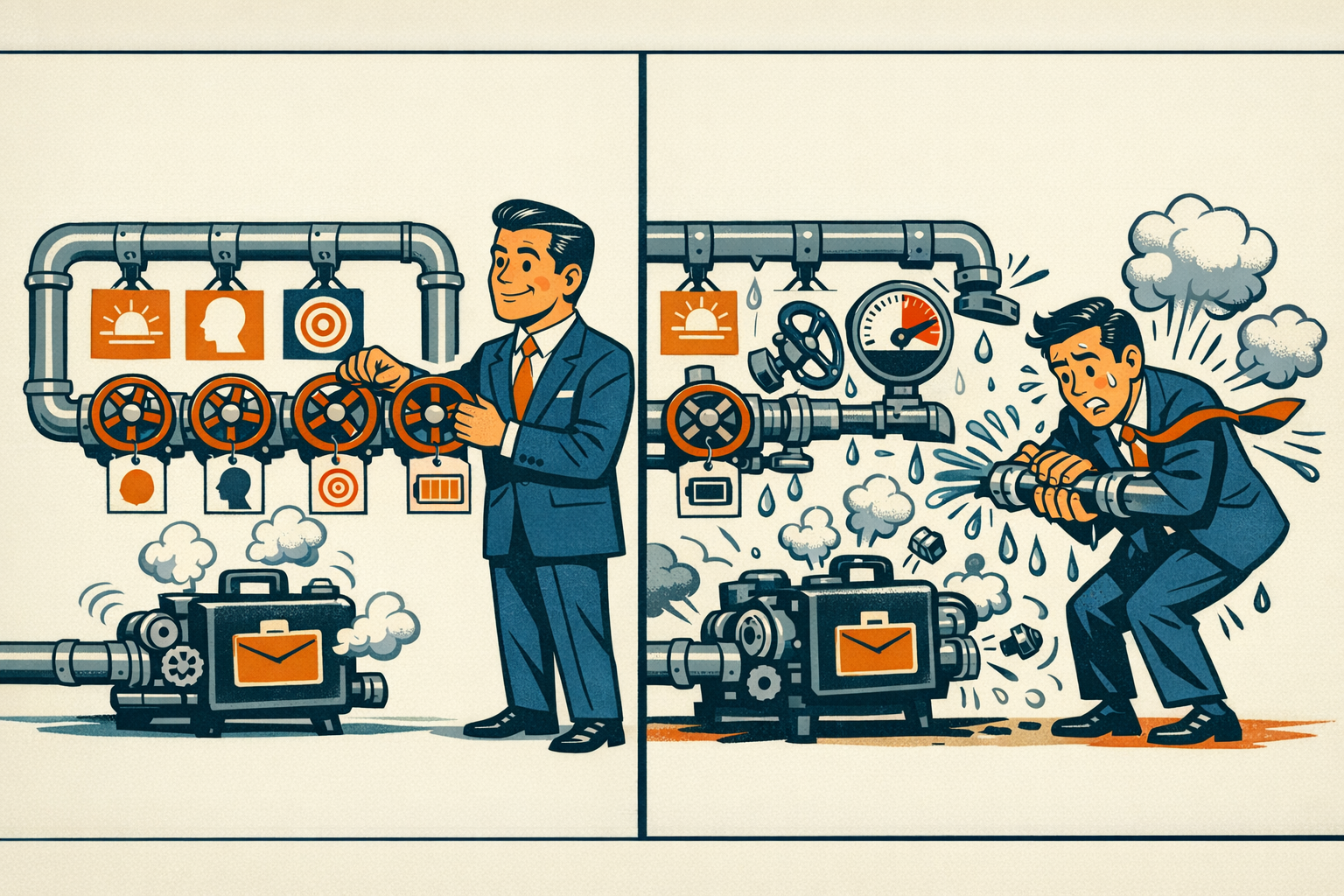
Most “growth problems” trace back to something simpler and more uncomfortable: the business keeps violating the owner’s constraints. The firm can look healthy on paper while the owner slowly checks out. And once that starts, the business often doesn't survive.
Owner’s Clarity is the discipline of making the owner’s constraints explicit, then building the firm around them, as part of the operating model.
Owner’s Clarity turns the owner into a design input
Constraints exist either way. Naming them gives you leverage. Leaving them vague turns them into a drag on your sanity and your firm's performance.
Often, owners keep trying to solve upstream symptoms with downstream effort:
- tweaking offers
- changing the value proposition
- pushing harder on business development
- buying someone else’s growth playbook
Without Owner’s Clarity, those moves often increase complexity while the owner’s internal constraints stay ignored. Even if growth is driven through sheer will and brute force, it still ends up multiplying the friction. Owner’s Clarity prevents that by ensuring that every strategic move you make in the business is in service of the life you actually want to live.
The Core Clarity Framework
Four constraints drive the whole system:
- Purpose: the internal why that supplies energy and patience
- Identity: the person the business is helping you become
- Intent: the outcomes the business must deliver, for you, in measurable terms
- Capacity: what you can sustainably handle across stress, risk, and energy
Those constraints can then be used to define your firm's two operating forces and one outcome.
- Purpose + Identity → Brand Integrity
The market-facing story, positioning, and culture match who you are and why the firm exists. - Intent + Capacity → Operating Discipline
The internal growth plan stays inside real constraints, with boundaries that hold. - Brand Integrity + Operating Discipline → Resilience
The business holds up under pressure because the external promises and internal realities match.
Resilience is the point.
Boutique consulting firms run founder-intensive by default. The founder sells. The founder delivers. The founder holds the relationships. The founder becomes the product. When the business model violates the owner’s constraints, the founder becomes the failure point. Owner’s Clarity fixes that at the source.
Let's dive deeper.
Constraint 1: Purpose
Purpose is the internal driver that supplies energy, meaning, and patience.
When purpose gets violated, founders experience a specific kind of fatigue. The work that used to feel energizing starts feeling heavy. The firm grows and the owner gets oddly bitter about the day-to-day.
In boutique consulting firms, purpose violations often show up as:
- selling work that fits capabilities but drains you
- keeping a client because it looks strategic while it poisons your week
- letting delivery expand into work you no longer want to lead
Practical management looks simple and hard:
- Design your role around energy-positive work even if that costs revenue in the short term
- Say no to work that violates purpose even if you can deliver it
Constraint 2: Identity
Identity is the person the business is helping you become. It includes who you want to be known as professionally and who you intend to be outside the business. In my sessions, one prompt consistently changes the quality of the conversation: define how you want to be seen. It tends to catch founders off guard, and it works because it bypasses the performative answer and reveals the real drivers underneath.
Why does that identity matter? Why does being seen that way matter? Keep going until the real motive shows up. That motive is likely your purpose. So identity tends to be the backdoor into your purpose.
Identity violations tend to look like:
- chasing validation through distractions and side quests
- avoiding commitments that lock you into the path you claim you want
- building a firm that requires you to play a role you do not respect
Managing identity means making it explicit inside leadership decisions:
- hiring
- deal selection
- delegation
- what you personally own versus hand off
A personal example: I am building toward being known as the “consulting founder whisperer” while also showing up as a fit, present dad. That identity requirement shapes my calendar and the work I take on.
Once identity has been identified, the business becomes the mechanism for consistently enabling it, rather than something you have to fight against to achieve it.
Constraint 3: Intent
Intent is what success looks like for you as the owner in real terms. It needs to be specific and measurable or it stays abstract and useless.
Founders often start with intent as a revenue number. Then they hit the number and still feel like they are losing. Or they move the goalposts because the original goal did not deliver what they expected.
The Owner’s Clarity process forces intent into future-state specificity:
- define the five-year horizon for life and business
- define the ideal rhythm of your day, week, month, and year
- define what success actually means for you
Then intent becomes operating requirements:
- target margin
- target deal size
- utilization assumptions
- max concurrent clients
- max founder hours per week
If the math does not work, you adjust the model. You don't settle.
Constraint 4: Capacity
Capacity is what you can sustainably handle across stress, risk, ambiguity, exposure, and doing hard things repeatedly. It includes time, but it also includes energy.
A useful way to surface capacity is scenario-based. Describe your “hell week” in detail, then define how long you could sustain that pace before something breaks. That conversation creates boundaries most founders never formalize, which is exactly why they keep violating them.
Capacity violations look like:
- oscillating between intensity and collapse
- ghosting your own initiatives
- calling it burnout while consistently overdrafting capacity
There is also a wiring component that founders ignore until it becomes expensive. Some activities drain energy even when you are good at them. For an introvert, heavy business development can be a net drain. For another founder, constant visibility and speaking can be a net gain. Keeping your energy capacity undefined, makes burnout an eventuality.
Managing capacity requires a capacity-aware growth plan:
- fewer priorities
- tighter deal filters
- clearer constraints on delivery
- intentional recovery cycles
The Constraint Alignment Test
Owner’s Clarity becomes operational when decisions run through four gates.
Every meaningful decision should clear these gates:
- Supports Purpose
- Reinforces Identity
- Delivers Intent in measurable terms
- Fits Capacity sustainably
This is the discipline that builds resiliency, both for the founder and for the firm.
This test applies to:
- clients you accept
- offers you build
- hires you make
- growth motions you invest in
- roles you keep for yourself
Where constraints hit the business
There are 12 business decisions shaped by Owner's Clarity constraints.
Purpose + Identity: Brand and culture
- founder story becomes the face of the business
- culture principles get anchored in why you started and how the business has shaped you
Purpose + Capacity: Delegation and hiring
- allocate resources to remove fear-based stressors from the owner’s plate
- build workflows around when the owner is most productive
Identity + Intent: Leadership and clientele
- choose a leadership approach that matches the leader you intend to be
- tier services based on your definition of success and the life you want
Identity + Capacity: Operational integrity
- invest in automation that protects the calendar from work that violates identity
- set office and location policies that match family trade-offs
Intent + Capacity: Growth and cash flow
- decide on reinvestment versus buying back time
- set profit targets that support the five-year life without overdrafting capacity
Purpose + Intent: Long-term direction
- assess market expansion against why you are running the business
- ensure the growth path matches the five-year picture and exit plan
This is why Owner’s Clarity belongs in the positioning conversation. Positioning is all about making bets and accepting trade-offs. Owner constraints change which bets make sense, and which trade-offs are acceptable.
Two real examples from boutique firms
1. The exit intent that the business structure cannot support
One founder I worked with, had clear intent: exit at a specific valuation, get paid, and be done. No earn-out. No extended transition.
The business structure made that impossible. The founder was still the face of the firm across thought leadership and sales and still owned almost all business development. That model did not command the valuation they wanted because the firm had key-person risk baked in.
The realit was that this founder had never really defined their purpose, and over time, being the founder, and the public persona became his identity. None of it was intentional. He was already burned out.
2. The founder who lost excitement for the work but found purpose in what the firm enabled
Another founder no longer felt excited by the consulting work itself. Growth, mentorship, and what the firm enabled outside the business became his energy drivers, including philanthropy and board service.
The work shifted. The constraints stayed aligned. The firm made sense because it supported the life and identity the founder cared about.
Deep introspection is required
If you want your business to grow, and for you to not be miseable while it does, this deep introspection work is step one. It's uncomfortable, and may initially feel unnecessary, but I guarantee you will find it worth it once that through line from Owner's Clarity to business performance becomes clear.
Suggested Reading
These posts connect cleanly to Owner’s Clarity and the downstream business decisions it drives:
- Owner’s Intent: Do You Know What Yours Is
- Your Firm Has a You Problem
- Living in Alignment: For You, Your Family, and Your Firm
Read to find clarity?
I am offering two of my readers the opportunity to identify their Purpose, Identity, Intent, and Capacity and see how they impact their business.
The Catch: we record these coaching sessions, and I turn them into a podcast episode. I'll of course ensure that no sensitive personal information is divulged.
This is a $6,000 service, I am offering for free, to two lucky readers.
The Process: send an email to mike.grinberg@proofpoint.marketing with "Owner's Clarity" in the subject line. Include your LinkedIn profile, and a short statement about why you feel this will be useful for you. Submissions will close on February 28th, after which I will choose the two people.