I've put off writing this newsletter for months... maybe even an entire year. I haven't written it because the pain of burnout, and the perceived stigma that comes with it, were still too fresh in my mind. But now that I've had time to reflect, and also help a number of my clients get through burnout or avoid it in the first place, I'm ready to share what I've learned, and the framework that can help you avoid burnout in the first place, while you work to grow your firm.
Burnout.
It's a word we've become all too familiar with as founders and entrepreneurs.
There has been a lot of research over the past several decades specifically exploring mental health and burnout in the entrepreneur population. It's all great data, and it tries to explain how and why founders are wired differently. But what it all seems to lack is an explanation of what is structurally going on within the business that creates the environment where burnout happens.
That's what I want to posit to you today: a new framework for understanding burnout through the lens of positioning.
Yes, founders tend to take on too much workload, but the question we don't often ask is: "where does that access workload come from?" I believe it comes from persistent misalignment across three positioning vectors:
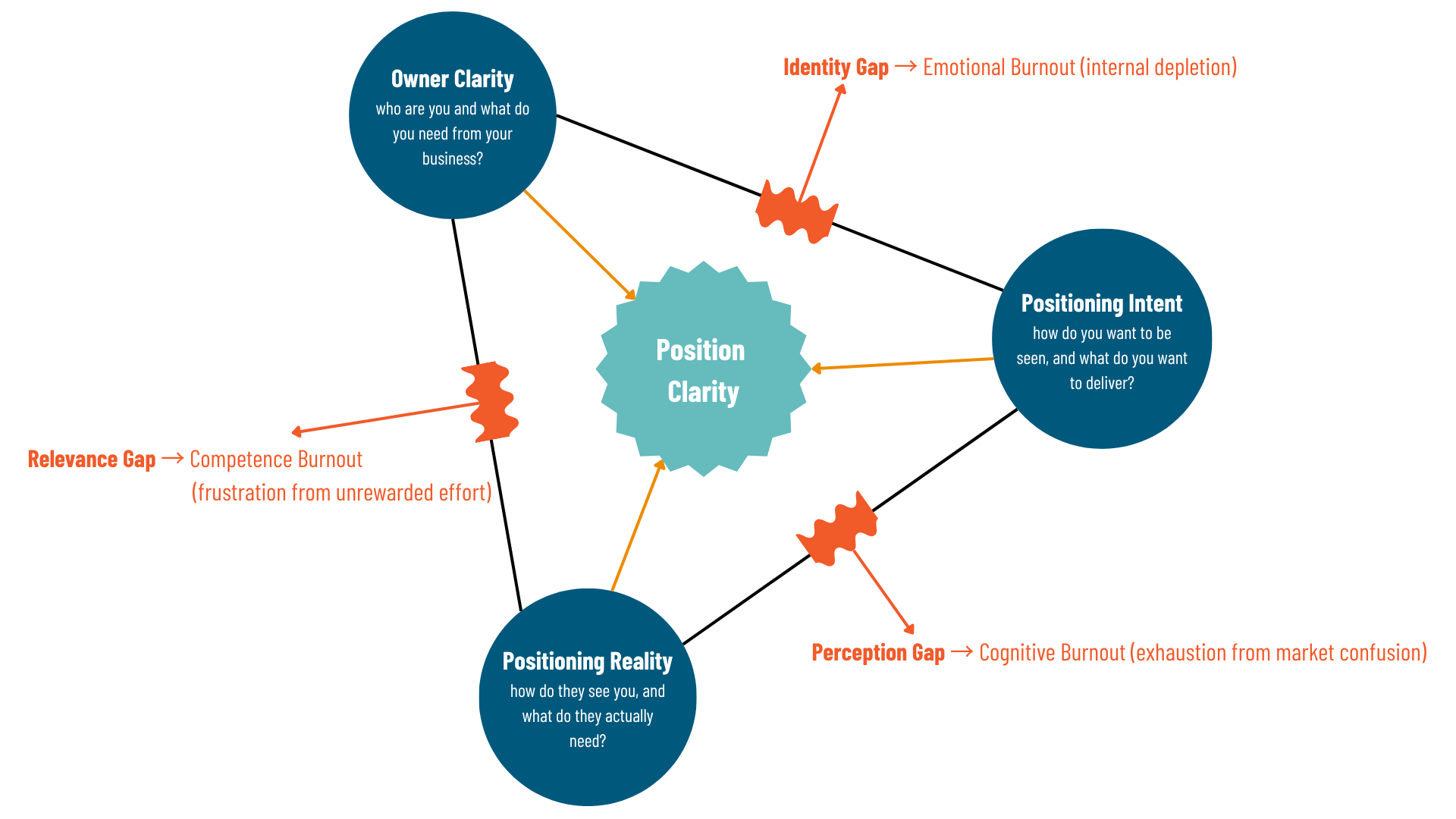
When Owner Clarity, Positioning Intent, and Positioning Reality don’t line up, you get three predictable gaps:
- Perception Gap: Cognitive Burnout (exhaustion from market confusion)
- Identity Gap: Emotional Burnout (internal depletion)
- Relevance Gap: Competence Burnout (frustration from unrewarded effort)
Most boutique founders can handle hard work. They burn out because the hard work isn't fulfilling, isn't recognized by the market, or isn't valued by the market. That's exhausting. So you either gain positioning clarity, or you face burnout.
Let's look at some of the research behind this pattern. You'll find that it maps cleanly onto this framework.
Founders are wired for the grind. That’s the problem.
Michael Freeman’s work is some of the most provocative in the entrepreneur mental health conversation. In one of the studies, 49% of entrepreneurs reported one or more lifetime mental health conditions (Freeman et al., 2018). So entrepreneurs seem to have a predisposition to mental health issues. This doesn't prove causality, but the number is jarring.
Freeman’s newer work goes a step further and points at a physiological root cause: entrepreneurs tend to have a dopaminergic profile. That's just a fancy way of saying that they are more likely than the average person to seek out behaviours that release dopamine: risk-taking, industriousness, relentless drive (Freeman et al., 2024). The same traits that make you good at building a business also make you vulnerable when there’s no constraint. When you don’t have a strategic filter, your default setting becomes “more.”
More offers. More channels. More custom work. More exceptions.
Without the appropriate constraints, a founder will lack the discipline necessary to stay focused. And what is positioning if not a set of constraints?
Intent vs. Reality: The Perception Gap Leads to Cognitive Burnout
Your Positioning Intent is how you want to be seen.
Your Positioning Reality is how the market actually sees you.
When those don’t match, you spend your time doing convincing work. convincing the market, your team, and even yourself, that you are something other than what they recognize you as. Do you remember what it was like to try to convince your future spouse that you were more put together, more romantic or more outgoing than you really were? Don't lie, we all put on at least a little bit of an act initially. Now do you remember the relief you felt when they called you out on it, and told you to just be yourself? Now imagine if that second part never happened and you had to keep putting on that act?
That is cognitive burnout.
And there's scientific research that proves this. Shepherd et al. (2010) found that role stress, especially role ambiguity and role conflict, is a direct antecedent to entrepreneurial burnout. If your market position is unclear, you live inside ambiguity, and a constant need to explain yourself and your firm. Winning new business becomes a game of convincing. You are either convincing them that what you do is more important than what they believe they need, or that you are something that they don't see you as. Either way, your role becomes whatever act you need to put on that day.
You can’t shut your brain off because your brain never gets closure.
You are always thinking about the next act you are going to have to put on. And possibly the worst part about this gap, is that it affects your entire team. They are all putting on the same act, and trying to compensate for this gap by putting out more content, attending more events, having more conversations, making more concessions. More. More. More.
If you find yourself rewriting your value proposition every time you send a proposal, you’re not refining. You’re compensating for the Perception Gap.
Owner Clarity vs Position Intent: The Identity Gap Leads to Emotional Burnout
This one sounds similar, but it's much more personal and sinister for the founder. The Identity Gap shows up when the founder’s internal clarity doesn’t match the firm’s external position. You’re doing work that technically “makes sense” but doesn’t fit who you are, how you want to lead, or what you want to be known for.
So you perform. You say yes to work that drains you because it keeps revenue stable. You keep clients that don’t respect your process because you don’t trust your pipeline. You keep your positioning broad because narrowing down feels like risking the business.
That’s how emotional burnout forms. It feels like self-betrayal.
Ho & Pollack (2014) described a related pattern as “identity fusion”—when a founder’s self-worth gets tied to the business so tightly that setbacks land as personal damage. If the firm isn’t clearly positioned, every lost deal becomes evidence you’re failing. Every slow month becomes a threat to your identity, not just your forecast.
Now layer in passion. Stroe et al. (2018) showed the connection between harmonious passion and obsessive passion. Harmonious passion fuels effort without consuming your life. Obsessive passion is the uncontrollable urge to work, even when it conflicts with everything else. According to the research, role overload pushes founders into obsessive passion. And the Identity Gap creates role overload by default. Because when your firm’s position is vague, you become the gap-filler. You patch the holes with your own time, your own stress tolerance, your own nights and weekends. All while feeling the strain of unfulfilling work.
Owner Clarity vs. Position Reality: The Relevance Gap Leads to Competence Burnout
Competence burnout is what happens when you are good at your craft, you’re working hard, and it still doesn’t pay off the way it should.
The market doesn't care that you have found your passion. The market cares about their problems and what they believe are solutions to solve them. And if they don't believe your passion will do the trick, you are toast.
You deliver what you believe is strong work. Clients seem happy while the engagement is happening, but after it's done, everyone is left feeling like something is off. Referrals trickle in. But the pipeline is inconsistent. Pricing feels fragile. You keep getting pulled into the same kind of messy, custom, under-defined engagements that take over your calendar and don’t compound. You might even be doing spec work, just to "prove yourself".
This is the Relevance Gap. Your passion is not aligned with what the market is willing to reward right now. So your effort doesn’t compound. This can be completely demoralizing. Anyone who has played a sport probably knows what this feels like. You love the game. You practice. You watch film. But then one day you are getting blown out and it's only the first half. That second half is likely the most mentally taxing thing you have ever had to do, because you still had to take the field, knowing that you have no chance, and you are going to take a further beating. You probably came home that night, feeling more mentally exhausted than ever before. That's what the Relevance Gap feels like for a founder, every day.
Kiefl et al. (2024) research shows that working while sick or depleted causes further mental exhaustion. While a Perception Gap isn't a recognized illness, it can definitely feel like one. You don’t stop because you don’t believe you can. You believe so strongly that your passion should matter, that you keep pushing. You keep taking the field even though you know you are going to get blown out.
Positioning Clarity vs. Marketing Activity
Most founders respond to these gaps with activity. New website copy. New outbound. New funnel. New partnership. New content cadence.
But that's just motion without direction.
Positioning Clarity is the strategic foundation that prevents those three gaps from forming in the first place. It forces alignment between what you intend, what the market perceives, and what actually gets rewarded.
Marketing is how you express your position. If your positioning is broken, no amount of activity will save your pipeline. Not in a sustainable way. Once burnout sets in, it's hard to break out of the cycle.
My Positioning Clarity Framework
This framework is simple on purpose. You don't need more theory. You need constraints you can easily apply to your business.
1) Owner Clarity
You decide what you are building and why it fits you.
Not aspirational nonsense. Real constraints:
- What work gives you energy.
- What work drains you.
- What kind of client relationship you will refuse.
- What kind of firm you actually want to run.
This matters because the Identity Gap is emotional debt. And emotional debt isn't good debt. At some point, that debt comes due.
2) Positioning Intent
You state your intended position with operational precision.
- Who you serve.
- What problem you solve.
- Why you win.
Ambiguity is expensive. It burns people out. Clear intent removes that ambiguity.
3) Positioning Reality
You test what the market believes right now.
Not what you wish they believed. Not what your website says. The live signal:
- What prospects ask on calls.
- What referrals say when they introduce you.
- What clients think you do “besides that one project.”
- What in-market buyers say they care about.
Founders often fight this because they believe they know better, or because they emotionally need something else to be true.
4) Position Clarity
You lock in the decisions and build a firm around them. Clarity isn't a sentence on a homepage. Clarity is when your sales process gets shorter because buyers self-select. Clarity is when you stop writing custom proposals because the offer is defined. Clarity is when you can say no without panic because the pipeline is built on a market position that makes sense.
And this is where recovery becomes possible. Wach et al. (2021) explored detachment as part of the solution. The study found that entrepreneurs who fail to "switch off" experience a cumulative build-up of stress that leads to clinical burnout. Position Clarity is what can make detachment possible because it reduces the constant low-grade uncertainty that keeps founders “on” all the time.
Your Burnout is Actually a Market Signal
If you’re burned out, ask a different question. What's the market actually telling you?
- If you’re mentally exhausted, you’re probably trapped in the Perception Gap. You’re doing constant explanation work because the market doesn’t know what you are.
- If you’re emotionally depleted, you’re probably trapped in the Identity Gap. You've assumed that the market needs you to do work that violates who you are and what you need from your business.
- If you’re frustrated and cynical, you’re probably trapped in the Relevance Gap. You’re competent, but the market isn’t rewarding it.
They’re positioning problems masquerading as mindset problems. But this isn't something where you can just "tough it out" or "stop feeling sorry for yourself" or "focus on your passion" or any of the other cliches you will hear from leadership and life coaches. These problems get fixed by understanding yourself, understanding the market, making a decision and building constraints around it.
If this hit a nerve, that’s a signal. Your next move is to close the gap, before the gap closes you.
Do You Have Positioning Clarity?
Your positioning needs to de-risk the buying decision for your ideal clients, because with more choice in the market (AI, fractional CXOs, offshore resources, etc.) the risk of choosing the wrong partner has increased exponentially. That risk has increased both for the individuals making the decisions, and for the organizations they work for.
Take the Positioning Clarity Assessment to uncover hidden issues making your firm a risky choice for your ideal clients.