Productize or Die Is Bad Advice

The standard playbook says productize to scale. But for boutique firms whose value is judgment, relationships, and bespoke thinking: that advice can destroy exactly what your clients pay for.

Productize or Die Is Bad Advice

The standard playbook says productize to scale. But for boutique firms whose value is judgment, relationships, and bespoke thinking: that advice can destroy exactly what your clients pay for.

Productize or Die Is Bad Advice

The standard playbook says productize to scale. But for boutique firms whose value is judgment, relationships, and bespoke thinking: that advice can destroy exactly what your clients pay for.

My clients who offer strategy as a service struggle with standardization. Whenever I bring up the need to standardize to them initially, they push back.

A founder of a digital transformation consulting firm told me flat out: "We can't productize. Our clients pay for bespoke strategy and solutions. That's what they know us for."

When discussing building out a standard entry-level assessment offering, a founder of an innovation consulting firm told me "I don't want this to look like a cookie cutter DIY assessment thing." ...Which definitely wasn't what I was suggesting... "They need to be in the room, interacting with us."

During the recent Operations of Positioning webinar an attendee asked "How do you keep bespoke work aligned with a firm’s position and vision as the organization grows and the founders or leadership team can no longer review every deliverable?" This one might seem out of place here, but it's the flip side of the same coin. "If we standardize things to keep enough consistency in delivery, then won't we ruin the bespoke nature of the work?"

In all of these examples, the founders are right to be wary. Their clients really did pay for judgment, relationships, and custom thinking. But they are incorrect in their assumption that the only alternative to standardization was chaos. Organized chaos, sure. But chaos nonetheless.

Here's the interesting part... all of these founders were actually concerned about productizing, not standardizing. They had actually already standardized certain things and didn't even realize it. Standard frameworks for diagnosing operating model maturity. Standard deliverables for specific diagnostics. Standard processes for workshops they ran over and over. Standard thinking that hadn't even been documented yet.

They weren't anti-standardization. They were anti-cookie-cutter. Those are very different things.

The Advice That's Costing You

You've heard it. Every consultant, every coach, every business advisor repeats the same line: niche down and productize.

At a high level, fine. Makes sense. You'd rather be a big fish in a small pond. But the productization part of that advice carries a dangerous assumption; that the only way to be profitable and to scale is to stop doing custom work.

That just isn't true.

For strategy firms, organizational design consultancies, digital transformation shops, architecture practices: bespoke is the differentiator. It's the reason clients hire you over the firms with bigger brands and deeper benches. Your judgment. Your ability to read a room, to diagnose a problem nobody else sees, and to build something that fits the client's specific context.

Productize that away and you've gutted the business.

Why the Binary Existed

The "productize or die" advice wasn't pulled from thin air. It was rooted in a real structural constraint.

To scale a bespoke firm historically, you had one lever... people. More partners. More senior consultants. More managing directors running teams of juniors. The classic consulting pyramid. That was the only way to scale bespoke delivery. And the consulting pyramid comes with its own set of problems: overhead, quality control, culture dilution, margin compression, etc.

Specialist productization emerged as the best alternative path. If you can't afford to hire ten more senior consultants, standardize the work so fewer people can deliver it. Strip out the judgment. Templatize the deliverables. Make it repeatable.

Capital efficiency on one side. Client centricity on the other. Pick one.

That was the trade-off. And for a long time, it was a real.

The Binary Is Dead

AI and automation have fundamentally changed the cost structure and capability set of a boutique firm. Not because AI replaces your judgment; it doesn't. But because AI lets you operationalize and scale that judgment without the pyramid.

Think about what that actually means. The constraint that forced the productization-or-people binary was execution capacity. You either needed humans to do the bespoke work or you needed to simplify the work so fewer humans could do it. Now there's a third option: keep the bespoke thinking, keep the custom output, and use AI to enable the execution layer underneath it.

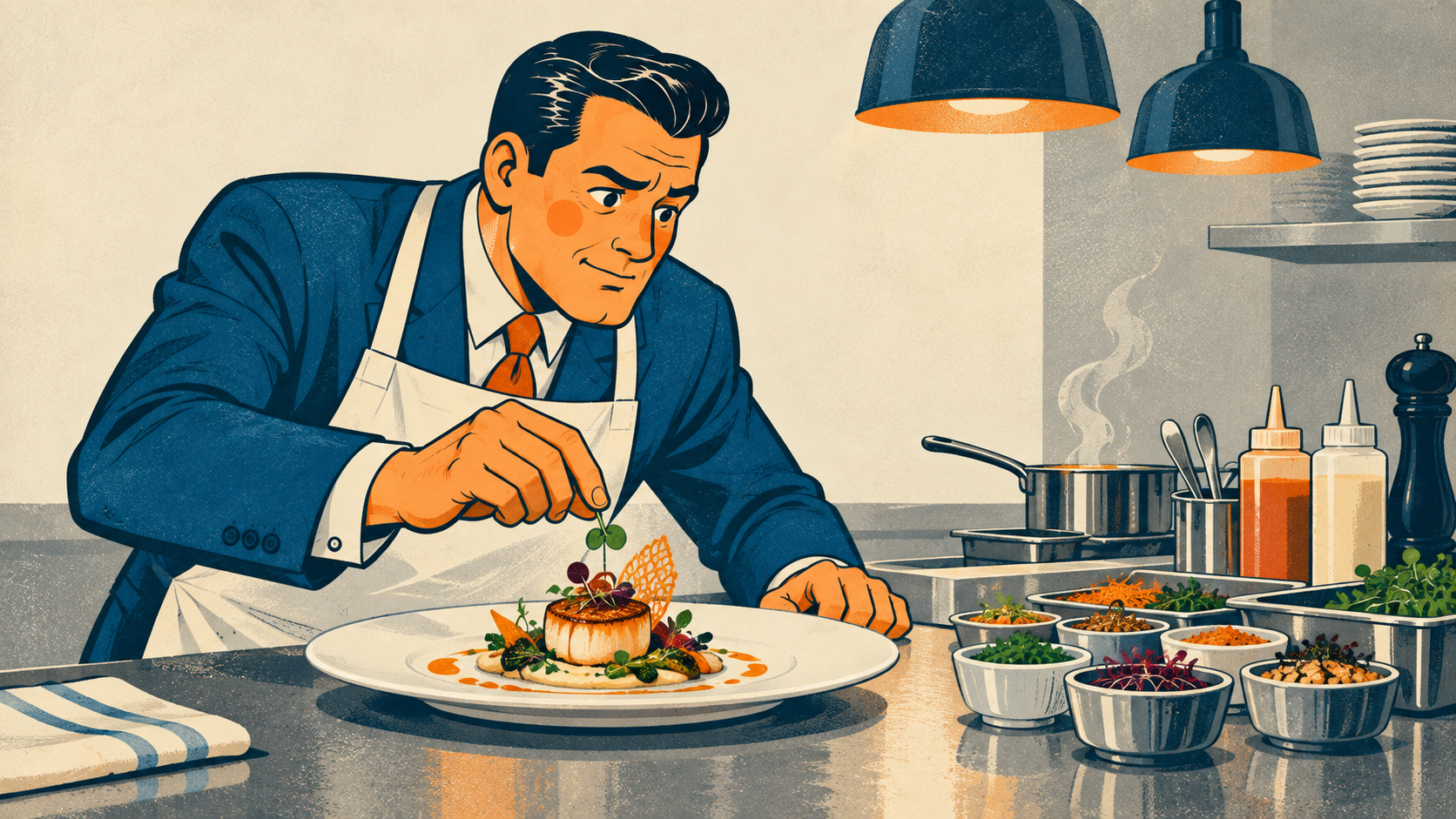
Think about a high-end restaurant kitchen. Every dish that goes out is composed for the diner; the chef reads the table, adjusts the plate, makes judgment calls in real time. That's the bespoke output. But underneath that... mise en place. Prep stations. Standardized techniques for stocks, sauces, and components that get assembled differently for every plate. The kitchen serves a hundred different dishes a night, each one custom, because the infrastructure underneath is standardized. One chef's judgment, scaled through systems, not through hiring ten more chefs.

The thinking and judgement stay custom; as do the relationship and account management. The methodologies, frameworks, and data models are standardized, to guide and enable that thinking and judgement. Processes are also standardized to keep work moving in a predictable fashion.

The output remains bespoke, while the infrastructure to deliver that output becomes standard.

The Real Problem Nobody's Naming

Most founders I work with feel this tension but can't always articulate it. They hear "productize" and their gut says no, but they can't explain why. Or they try to productize and the work gets worse. Clients notice. Margins don't actually improve because the sales cycle gets harder when your offer sounds like everyone else's.

The problem is a Perception Gap. Your market knows you for bespoke, high-judgment work. You start productizing. The work starts feeling generic. Your clients sense the shift before you do. And the gap between how you want to be perceived and how the market actually experiences you starts widening. Once that gap opens, it's expensive to close.

These founders are sensing a real risk. The mistake is thinking the only alternative to that risk is staying small or hiring your way to scale.

What's Coming Next

Over the next few week, I'm breaking this open, by diving into:

  • The actual spectrum of delivery models that exists between fully custom and fully productized.
  • How to build the methodology infrastructure that makes all of these models work.
  • Where AI fits into this picture, practically, not hypothetically.
  • And how all of this connects back to maintaining your positioning in the market.

This is the question I'm exploring: Can you scale bespoke? Not by diluting it. Not by pyramiding your way up. Not by pretending your custom work is a product. By actually building the operational backbone that lets your best thinking reach more clients without losing the thing that makes it valuable.

I believe the answer is yes. But the path looks nothing like the standard advice.

If this tension resonates, shoot me an email: mike.grinberg@proofpoint.marketing

Mike Grinberg

My clients who offer strategy as a service struggle with standardization. Whenever I bring up the need to standardize to them initially, they push back.

A founder of a digital transformation consulting firm told me flat out: "We can't productize. Our clients pay for bespoke strategy and solutions. That's what they know us for."

When discussing building out a standard entry-level assessment offering, a founder of an innovation consulting firm told me "I don't want this to look like a cookie cutter DIY assessment thing." ...Which definitely wasn't what I was suggesting... "They need to be in the room, interacting with us."

During the recent Operations of Positioning webinar an attendee asked "How do you keep bespoke work aligned with a firm’s position and vision as the organization grows and the founders or leadership team can no longer review every deliverable?" This one might seem out of place here, but it's the flip side of the same coin. "If we standardize things to keep enough consistency in delivery, then won't we ruin the bespoke nature of the work?"

In all of these examples, the founders are right to be wary. Their clients really did pay for judgment, relationships, and custom thinking. But they are incorrect in their assumption that the only alternative to standardization was chaos. Organized chaos, sure. But chaos nonetheless.

Here's the interesting part... all of these founders were actually concerned about productizing, not standardizing. They had actually already standardized certain things and didn't even realize it. Standard frameworks for diagnosing operating model maturity. Standard deliverables for specific diagnostics. Standard processes for workshops they ran over and over. Standard thinking that hadn't even been documented yet.

They weren't anti-standardization. They were anti-cookie-cutter. Those are very different things.

The Advice That's Costing You

You've heard it. Every consultant, every coach, every business advisor repeats the same line: niche down and productize.

At a high level, fine. Makes sense. You'd rather be a big fish in a small pond. But the productization part of that advice carries a dangerous assumption; that the only way to be profitable and to scale is to stop doing custom work.

That just isn't true.

For strategy firms, organizational design consultancies, digital transformation shops, architecture practices: bespoke is the differentiator. It's the reason clients hire you over the firms with bigger brands and deeper benches. Your judgment. Your ability to read a room, to diagnose a problem nobody else sees, and to build something that fits the client's specific context.

Productize that away and you've gutted the business.

Why the Binary Existed

The "productize or die" advice wasn't pulled from thin air. It was rooted in a real structural constraint.

To scale a bespoke firm historically, you had one lever... people. More partners. More senior consultants. More managing directors running teams of juniors. The classic consulting pyramid. That was the only way to scale bespoke delivery. And the consulting pyramid comes with its own set of problems: overhead, quality control, culture dilution, margin compression, etc.

Specialist productization emerged as the best alternative path. If you can't afford to hire ten more senior consultants, standardize the work so fewer people can deliver it. Strip out the judgment. Templatize the deliverables. Make it repeatable.

Capital efficiency on one side. Client centricity on the other. Pick one.

That was the trade-off. And for a long time, it was a real.

The Binary Is Dead

AI and automation have fundamentally changed the cost structure and capability set of a boutique firm. Not because AI replaces your judgment; it doesn't. But because AI lets you operationalize and scale that judgment without the pyramid.

Think about what that actually means. The constraint that forced the productization-or-people binary was execution capacity. You either needed humans to do the bespoke work or you needed to simplify the work so fewer humans could do it. Now there's a third option: keep the bespoke thinking, keep the custom output, and use AI to enable the execution layer underneath it.

Think about a high-end restaurant kitchen. Every dish that goes out is composed for the diner; the chef reads the table, adjusts the plate, makes judgment calls in real time. That's the bespoke output. But underneath that... mise en place. Prep stations. Standardized techniques for stocks, sauces, and components that get assembled differently for every plate. The kitchen serves a hundred different dishes a night, each one custom, because the infrastructure underneath is standardized. One chef's judgment, scaled through systems, not through hiring ten more chefs.

The thinking and judgement stay custom; as do the relationship and account management. The methodologies, frameworks, and data models are standardized, to guide and enable that thinking and judgement. Processes are also standardized to keep work moving in a predictable fashion.

The output remains bespoke, while the infrastructure to deliver that output becomes standard.

The Real Problem Nobody's Naming

Most founders I work with feel this tension but can't always articulate it. They hear "productize" and their gut says no, but they can't explain why. Or they try to productize and the work gets worse. Clients notice. Margins don't actually improve because the sales cycle gets harder when your offer sounds like everyone else's.

The problem is a Perception Gap. Your market knows you for bespoke, high-judgment work. You start productizing. The work starts feeling generic. Your clients sense the shift before you do. And the gap between how you want to be perceived and how the market actually experiences you starts widening. Once that gap opens, it's expensive to close.

These founders are sensing a real risk. The mistake is thinking the only alternative to that risk is staying small or hiring your way to scale.

What's Coming Next

Over the next few week, I'm breaking this open, by diving into:

  • The actual spectrum of delivery models that exists between fully custom and fully productized.
  • How to build the methodology infrastructure that makes all of these models work.
  • Where AI fits into this picture, practically, not hypothetically.
  • And how all of this connects back to maintaining your positioning in the market.

This is the question I'm exploring: Can you scale bespoke? Not by diluting it. Not by pyramiding your way up. Not by pretending your custom work is a product. By actually building the operational backbone that lets your best thinking reach more clients without losing the thing that makes it valuable.

I believe the answer is yes. But the path looks nothing like the standard advice.

If this tension resonates, shoot me an email: mike.grinberg@proofpoint.marketing

Mike Grinberg

My clients who offer strategy as a service struggle with standardization. Whenever I bring up the need to standardize to them initially, they push back.

A founder of a digital transformation consulting firm told me flat out: "We can't productize. Our clients pay for bespoke strategy and solutions. That's what they know us for."

When discussing building out a standard entry-level assessment offering, a founder of an innovation consulting firm told me "I don't want this to look like a cookie cutter DIY assessment thing." ...Which definitely wasn't what I was suggesting... "They need to be in the room, interacting with us."

During the recent Operations of Positioning webinar an attendee asked "How do you keep bespoke work aligned with a firm’s position and vision as the organization grows and the founders or leadership team can no longer review every deliverable?" This one might seem out of place here, but it's the flip side of the same coin. "If we standardize things to keep enough consistency in delivery, then won't we ruin the bespoke nature of the work?"

In all of these examples, the founders are right to be wary. Their clients really did pay for judgment, relationships, and custom thinking. But they are incorrect in their assumption that the only alternative to standardization was chaos. Organized chaos, sure. But chaos nonetheless.

Here's the interesting part... all of these founders were actually concerned about productizing, not standardizing. They had actually already standardized certain things and didn't even realize it. Standard frameworks for diagnosing operating model maturity. Standard deliverables for specific diagnostics. Standard processes for workshops they ran over and over. Standard thinking that hadn't even been documented yet.

They weren't anti-standardization. They were anti-cookie-cutter. Those are very different things.

The Advice That's Costing You

You've heard it. Every consultant, every coach, every business advisor repeats the same line: niche down and productize.

At a high level, fine. Makes sense. You'd rather be a big fish in a small pond. But the productization part of that advice carries a dangerous assumption; that the only way to be profitable and to scale is to stop doing custom work.

That just isn't true.

For strategy firms, organizational design consultancies, digital transformation shops, architecture practices: bespoke is the differentiator. It's the reason clients hire you over the firms with bigger brands and deeper benches. Your judgment. Your ability to read a room, to diagnose a problem nobody else sees, and to build something that fits the client's specific context.

Productize that away and you've gutted the business.

Why the Binary Existed

The "productize or die" advice wasn't pulled from thin air. It was rooted in a real structural constraint.

To scale a bespoke firm historically, you had one lever... people. More partners. More senior consultants. More managing directors running teams of juniors. The classic consulting pyramid. That was the only way to scale bespoke delivery. And the consulting pyramid comes with its own set of problems: overhead, quality control, culture dilution, margin compression, etc.

Specialist productization emerged as the best alternative path. If you can't afford to hire ten more senior consultants, standardize the work so fewer people can deliver it. Strip out the judgment. Templatize the deliverables. Make it repeatable.

Capital efficiency on one side. Client centricity on the other. Pick one.

That was the trade-off. And for a long time, it was a real.

The Binary Is Dead

AI and automation have fundamentally changed the cost structure and capability set of a boutique firm. Not because AI replaces your judgment; it doesn't. But because AI lets you operationalize and scale that judgment without the pyramid.

Think about what that actually means. The constraint that forced the productization-or-people binary was execution capacity. You either needed humans to do the bespoke work or you needed to simplify the work so fewer humans could do it. Now there's a third option: keep the bespoke thinking, keep the custom output, and use AI to enable the execution layer underneath it.

Think about a high-end restaurant kitchen. Every dish that goes out is composed for the diner; the chef reads the table, adjusts the plate, makes judgment calls in real time. That's the bespoke output. But underneath that... mise en place. Prep stations. Standardized techniques for stocks, sauces, and components that get assembled differently for every plate. The kitchen serves a hundred different dishes a night, each one custom, because the infrastructure underneath is standardized. One chef's judgment, scaled through systems, not through hiring ten more chefs.

The thinking and judgement stay custom; as do the relationship and account management. The methodologies, frameworks, and data models are standardized, to guide and enable that thinking and judgement. Processes are also standardized to keep work moving in a predictable fashion.

The output remains bespoke, while the infrastructure to deliver that output becomes standard.

The Real Problem Nobody's Naming

Most founders I work with feel this tension but can't always articulate it. They hear "productize" and their gut says no, but they can't explain why. Or they try to productize and the work gets worse. Clients notice. Margins don't actually improve because the sales cycle gets harder when your offer sounds like everyone else's.

The problem is a Perception Gap. Your market knows you for bespoke, high-judgment work. You start productizing. The work starts feeling generic. Your clients sense the shift before you do. And the gap between how you want to be perceived and how the market actually experiences you starts widening. Once that gap opens, it's expensive to close.

These founders are sensing a real risk. The mistake is thinking the only alternative to that risk is staying small or hiring your way to scale.

What's Coming Next

Over the next few week, I'm breaking this open, by diving into:

  • The actual spectrum of delivery models that exists between fully custom and fully productized.
  • How to build the methodology infrastructure that makes all of these models work.
  • Where AI fits into this picture, practically, not hypothetically.
  • And how all of this connects back to maintaining your positioning in the market.

This is the question I'm exploring: Can you scale bespoke? Not by diluting it. Not by pyramiding your way up. Not by pretending your custom work is a product. By actually building the operational backbone that lets your best thinking reach more clients without losing the thing that makes it valuable.

I believe the answer is yes. But the path looks nothing like the standard advice.

If this tension resonates, shoot me an email: mike.grinberg@proofpoint.marketing

Mike Grinberg